Patterned Polar Bears
Angelo CerantolaAngelo Cerantola illustrates the natural world through a rhythmic lens, layering intricate motifs onto the heavy silhouettes of Arctic wildlife. In this piece, the polar bear becomes a canvas for repeating geometries, merging the wild spirit of the animal with the precision of digital craft.
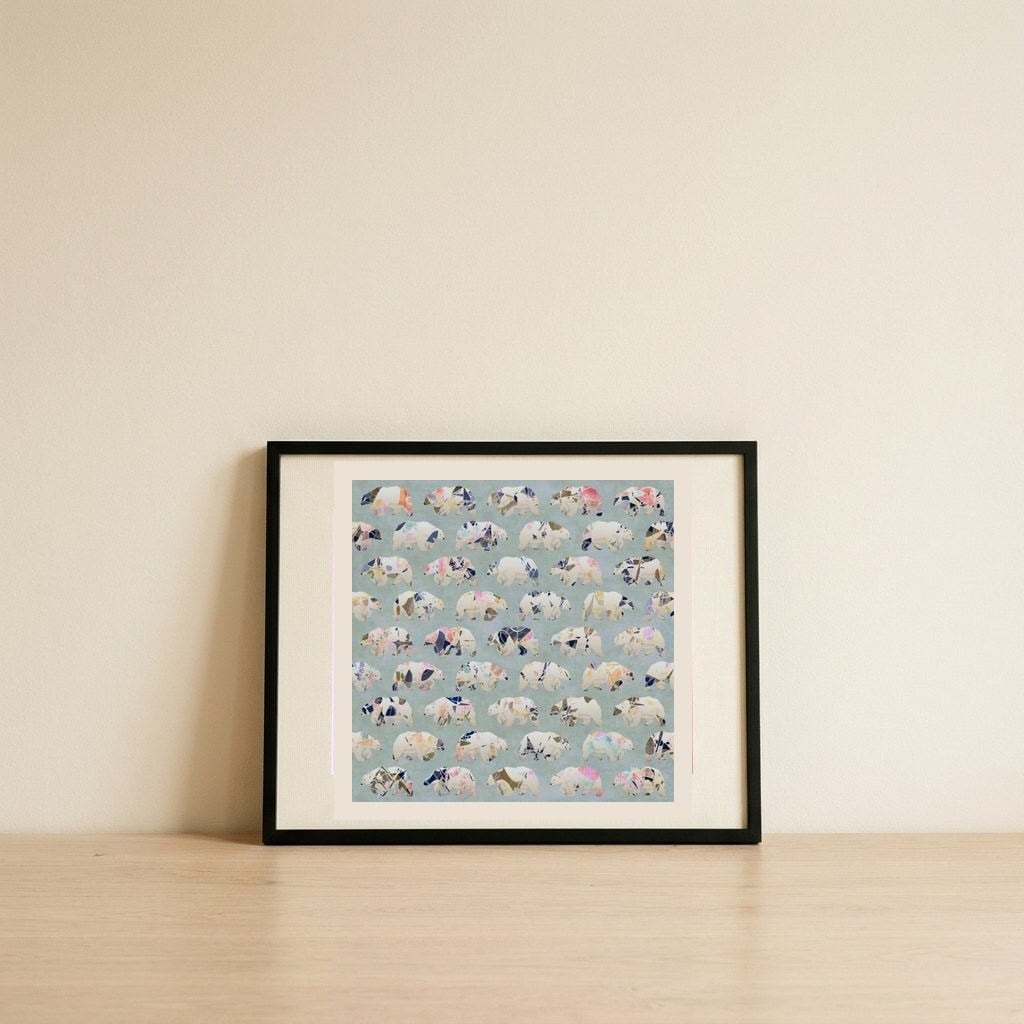
Patterned Polar Bears
Angelo Cerantola illustrates the natural world through a rhythmic lens, layering intricate motifs onto the heavy silhouettes of Arctic wildlife. In this piece, the polar bear becomes a canvas for repeating geometries, merging the wild spirit of the animal with the precision of digital craft.
30 × 30 cm · about ⅙ the width of a 3-seat sofa
A meaningful share of this purchase goes directly to Angelo Cerantola.
Every Arthaus piece supports a living artist.
Patterned Polar Bears
Angelo Cerantola
Art Analysis
Arctic silhouettes defined by intricate geometric rhythms
In this squared composition, Cerantola reimagines the polar bear not as a literal creature of ice and fur, but as a vessel for complex ornamentation. The illustration balances the organic weight of the animals with a meticulous application of patterns, creating a visual tension between the vastness of nature and the structured detail of digital art. By stripping away environmental realism, the artist focuses on the interplay of shape and repetition, inviting a closer look at the decorative textures that define the forms.
The work utilizes a clean, illustrative approach to explore the intersection of biology and abstraction. Each line and motif serves to contour the subjects, giving them a sense of presence that feels both grounded and imaginative. This approach highlights a fascination with how mathematical regularity can coexist with the fluid shapes of the animal kingdom, resulting in a piece that feels deeply intentional and visually rhythmic.
The piece utilizes crisp digital tools to render smooth gradients and sharp outlines that define its playful subjects.
The natural form of the polar bear is reimagined through the application of repetitive, non-representational motifs.
Abstract elements are used to break down the subject into a series of patterns, emphasizing texture over realism.
Free Shipping
On all framed orders
100-Day Guarantee
Love it or return it
Gallery Quality
Museum-grade materials
Artist-Direct
Fair pay, every piece
More to Discover
More from Angelo Cerantola
ArtistMore of Angelo Cerantola’s work, hand-picked from the collection.